To see what one has not seen before, is not that almost as good as to a see what no one has ever seen? -Beerbohm
|
|
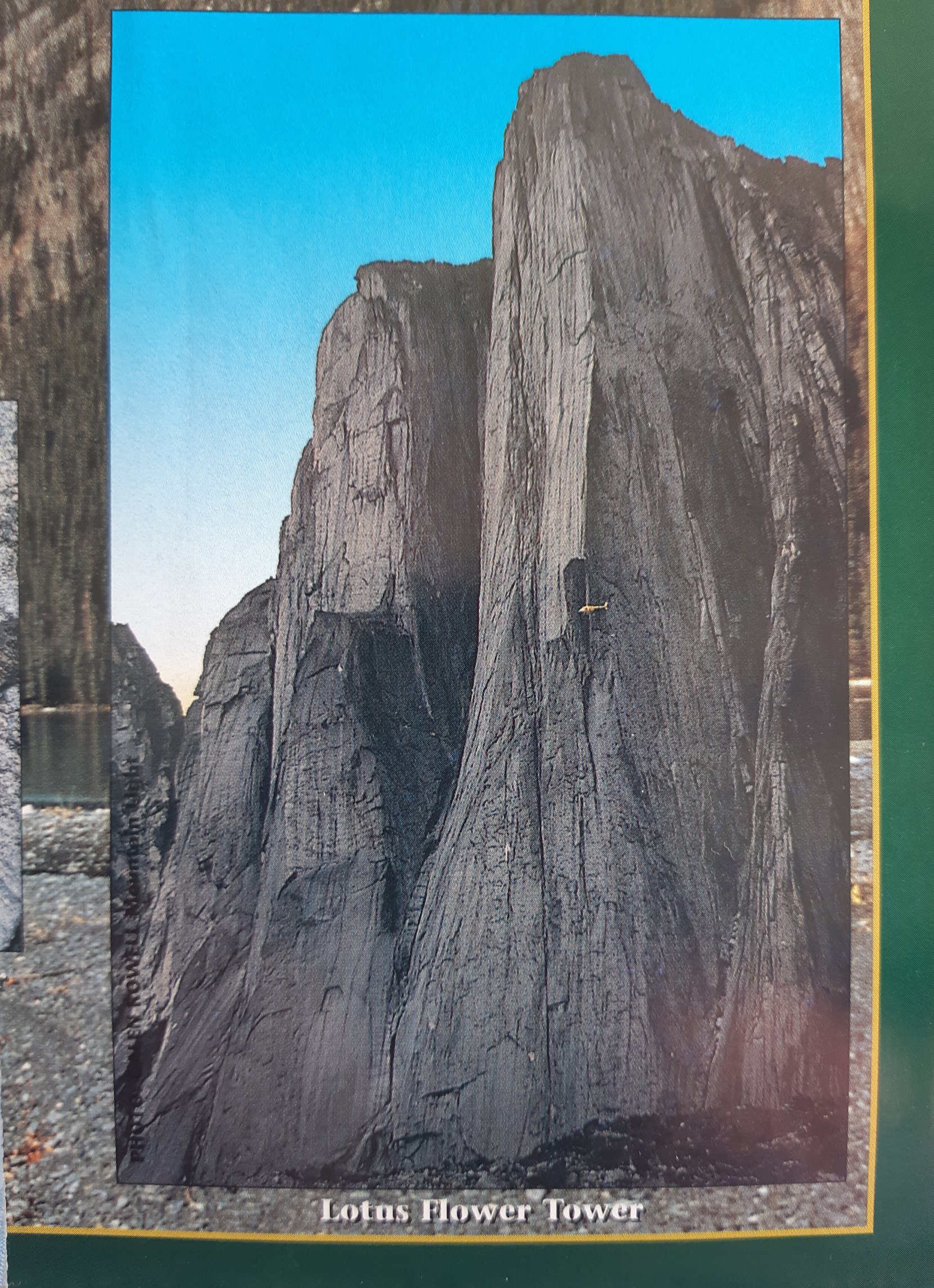
| Lotus Flower Tower (note helicopter) |
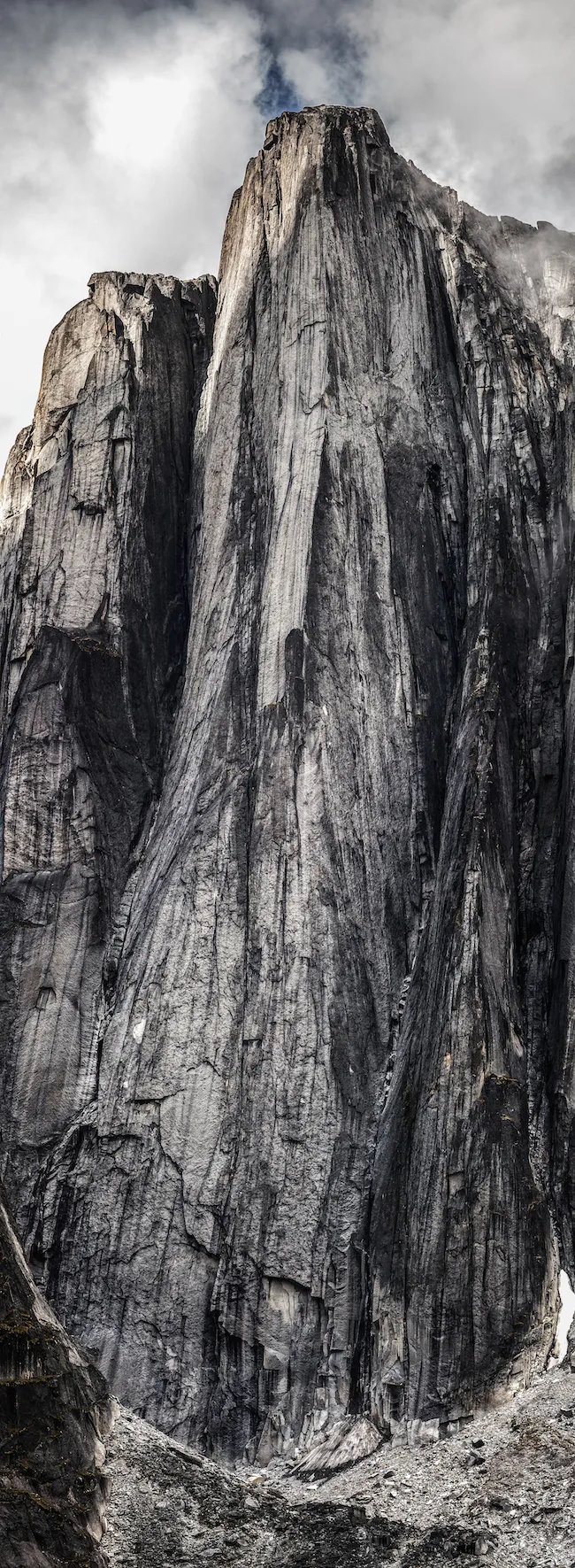
The attraction of the Lotus Flower Tower lies in the elegance of its slender shape, the wild and uncompromising surroundings and the pure aesthetics of the headwall cracks. Rising for 670m above a small glacier, the Lotus stands majestically as one element in the continuous granite wall which comprises the Cirque of the Unclimbables. Within this 'Forgotten Yosemite' there is sufficient rock to keep future generations busy for years, yet to date there have been fewer than 60 routes opened in the entire area. This is attributable to the logistics involved in reaching the area (one has to fly in via float-plane from the nearest permanent civilization at Watson Lake, a distance of over 200 km), the feeling of being out on a very long limb once there, and the weather.
Only a few dozen climbers visit the Cirque each summer and most come to climb the South East Face on the Lotus Flower Tower which has been described as 'undoubtedly one of the best rock climbs in the world'. Crowds are not a problem here, but traffic jams on the route have occurred during periods of good weather.
I remember Transvaal section member Eckhardt Druschke enthusing about the area to me in the early 1980s. He raved about the fantastic cracks, the remoteness and the fact that, if a helicopter approach to the Fairy Meadows was used, the base camp was less than two minutes walk away. Eckhardt climbed the Lotus in 1982 with the American Mugs Stump and hence made the first South African ascent. Transvaal Section member Alex Harris and party visited the Cirque in 1995, but were prevented from climbing by bad weather: they returned to South Africa frustrated that they had touched but not cranked the Lotus.
Despite the fact that the belay stations are now all bolted, the route is not a 'sun-kissed clip-up'; and it still evokes a great feeling of adventure. It was opened in 1968 by Jim McCarty, Sandy Bill and Tom Frost: free, the routes goes at a respectable 5.10c (about grade 22), with every pitch on the headwall in the grade 17 to 22 range. More worrying than the difficulty of the climbing is the fickle weather of the region. The Cirque lies at 62? north and is 500km south of the Arctic Circle: this means that when the wind blows for the north things get cold and often very wet. Snowfalls from the previous winter are a big problem - if one goes to the area too early in the summer there can be large volumes of the white stuff still lying around, making approach difficult. If one arrives too late in summer (August), the snows of the next winter can arrive at the same time.
|
| Lotus Flower Tower |
Paul and I wanted to introduce some younger Section members to the delights of expedition life and we were pleased when Mark, Grant and Matt, three talented rock-jocks, said they would be keen to join us. We brought years of experience to the team, and Matt, Grant and Mark, were to contribute strong arms and fingers and enthusiasm: this was to prove a mutually beneficial arrangement. With these fine young men I knew Paul and I would grow - an important reason for choosing any mountain company.
Our planning commenced in February. A good source of material was the internet, particularly information filed there by Cirque-guru George Bell of Colorado. We were aware that we would be taking a calculated risk in arriving in the cirque during the last week of June (so as to have sufficient time for at least two attempts at the Tower before Paul would have to leave to be in Vancouver on 8 July). There might, we knew, be lots of snow around. A few e-mail enquiries confirmed that an early arrival would be no more risky than arriving after July 15, when the route might get busy. Tents, rucksacks and slide film were obtained from various commercial sponsors and, with minor financial support and a concessionary air-ticket provided by the Transvaal Section and the MCSA National Expedition Fund, we flew to Vancouver, British Colombia.
First base camp was established on the Vancouver back lawn of Robin Barley whose climbs of the 1960s and 1970s in the Transvaal and Western Cape are still legendary. He and Cape Town Section member Doug Jamieson provided us with invaluable local information, ideas on where to train, and where to shop for food, and moral support. In order to become acquainted with climbing granite, we twice visited Squamish Chief, about an hour and a half's drive north of Vancouver, and climbed sections of the magnificent Grand Wall. As we packed for our journey north, western Canada was enjoying a heat wave.
The most economical - and educational- method of transporting four adults and 300kg of food and gear 2000km north was the Greyhound bus. This afforded us the opportunity of seeing what British Colombia was like (not all conifers and lakes) and of meeting some interesting people, including students going north to earn mega-bucks by tree planting. At times the Alaskan Highway was tedious, but then the driver would slow down and announce: "Young caribou/elk/black bear on the left!" Thirty nine hours after we had left Vancouver, Paul (who had arrived earlier from Whitehorse), flagged the bus down in the half-horse town which is Watson Lake. Twenty three hours of daylight was more than enough time in which to view the attractions of the town. The heat, black flies and mosquitoes added to the discomfort.
On the morning of June 24, Robert Close of Watson Lake Flying Services collected us, relieved us of a mound of traveler's cheques and carefully weighed our total consignment (bodies, gear, food and fuel). As the small doors of the Beaver and the Cessna closed and we roared off over Watson Lake into an azure sky, we knew our adventure was truly underway. The flight to Glacier Lake was a revelation - the kilometres of wild backcountry underlined how remote our position was to be. Matt and Grant gasped in awe when the South Nahanni River came into view - they were to do a 360km rafting journey down it, after the climbing. As we swung into the broad river valley we had our first glimpses of the Cirque: even from this distance we could discern the Lotus Flower Tower and the snow cone sitting on the half-height bivouac ledge. It was a marvelous sight. Then the float planes splashed down onto the calm surface of Glacier Lake and the journey was over.
Having bade farewell to our two pilots, we sat on our small mound of gear and food and listened to the deafening silence. We could have been on another planet, such was the lack of man-made sound. In the heat and amongst the mozzies we slung the bulk of our food plus the raft in trees to render them bear-proof. If we were to carry all the climbing hardware, personal effects, tentage, stoves and fuel, we would only have capacity on our initial walk-in to carry food for the first six days. Groaning under the 40kg packs we began our slow journey along the banks of Brintnell Creek, the main tributary of Glacier Lake, and then up the horror talus slope under Mt Sir Harrison Smith. Alex Harris had warned me that so tedious and dangerous was this boulder-filled slope that we would only want to do this walk-in once; we resigned ourselves to twice. After six and a half hour slog we arrived tired but elated at Fairy Meadow, the delightful alpine meadow at the entrance to the first of the four cirques. Surrounding us were the magnificent rock towers and walls we had read about - Proboscis, Flat Top, Bustle Tower, Mt Sir James MacBrien, Crescent Peak.
Sipping soup under the 500 metre-high north face of Mt Sir Harrison Smith, I wondered why we undertake these expeditions. Why go to these wild and dangerous places and expose ourselves to the risks year after year? Perhaps it's part of a self-humbling exercise; maybe we otherwise become too full of our own self-importance? Or is it just to climb?
On June 25, still tired from the exertions of the walk-in, we organized our Base Camp and planned to climb. A large tarpaulin which Robin had loaned us proved invaluable as an all-weather communal cooking shelter, dining area and crucible of tactical debate. Observed by hoary marmots we rested and tried to make pancakes using the only available oil - from sardines (retch!) Two young Swiss climbers, the only others in the Cirque, told us their epic stories of wading through thigh-deep snow (they had arrived on June 10), and of not having completed the Lotus 'one-day ascent' strategy because of badly snagged ropes on their abseil descent. As we plodded up the moraine, skirting some snow patches, to dump all the ropes and hardware at the foot of the route that afternoon, I couldn't fully grasp that the line could be so simple, yet so elegant and desirable. Could we get on at the ground floor and ride it for nineteen pitches? Grant and Matt frolicked in the snow below the Tower - the first they had encountered. Going to bed early that evening, in what seemed like full daylight, I felt the knot of anticipation and excitement binding my stomach. 'We've come so far, we've come so far ...' was the dreamscape mantra.
All the training, saving, planning, spending and traveling culminated in Mark leading the first pitch (grade 18) at 8 am on the morning of June 26, after a 4.30 am start. Wild horses would not have prevented our young friends from climbing first; Paul and I (combined age 89 years) were happy to make up a second party. The first three pitches constituted the difficulties on Day One - a steep dihedral and under-roof traverse. This corner is often wet and so I was very relieved to find it almost dry. Striding over the half-metre-wide bergschrund onto the grey granite I felt a huge sigh of relief - we were off at last! Paul and I decided to haul our pack containing spare clothing, food and the stove, rather than have the person climbing second with this not inconsiderable weight on his back.
After pitch three there is a distinct change of angle as one exits onto a slabby wall. Here the climbing was relatively straightforward (about grade 17) - first two pitches up small corners and then five pitches up an open groove. The rock was dry and generally solid, the weather immaculate; as we ascended pitch after pitch without difficulty we were filled with a glowing calm. Small, yellow alpine flowers nodded in the gentle breeze as we passed. What a way to spend one's birthday, I thought. The chimney on pitch nine and the wet, awkward corner above added some spice to the end of the day.
In his account of the first ascent, McCarthy, anxious about the forthcoming bivouac, yelled up to Frost, enquiring if the newly found site was adequate. "It looks all right," floated back the reply,"if you happen to like flat grass." Strangely, this elevated meadow, the plan large enough to hold two small cars, does not possess a romantic name: it isn't 'The Lotus Lodge' or 'The Ledge of Dreams'. Pulling up onto the ledge at 8:30 pm, about two hours after Matt, Grant and Mark, Paul and I expected to be greeted with congratulations on a good day's climbing. But - by that time the wind was increasing and the lack of movement had left our three colleagues chilled: we were met with a frosty but friendly: "Who's got the wretched stove!?" As soup was prepared using melted snow from the large snow cone, Grant and Matt celebrated the day's achievements with a cigar.
Our evening meal of tea, peanuts, dates, fruit roll, energy bars and coffee tasted like a feast. During the next few hours a strategic error was to manifest itself - we should have taken sleeping bags. We had opted for a lightweight approach using layered clothing, duvet jackets and bivi-bags (for those who had them - Mark, Paul and I). As the long cold hours dragged by, sleep was fitful (with bag) or non-existent (without). Grant and Matt huddled and slapped the night away - when they weren't making tea! It was dusk from about 3 am, but the sun didn't reach us until 6 am: the sun's slow arc is the problem associated with long daylight hours. In the golden glow of dawn the Headwall towered above us.
|
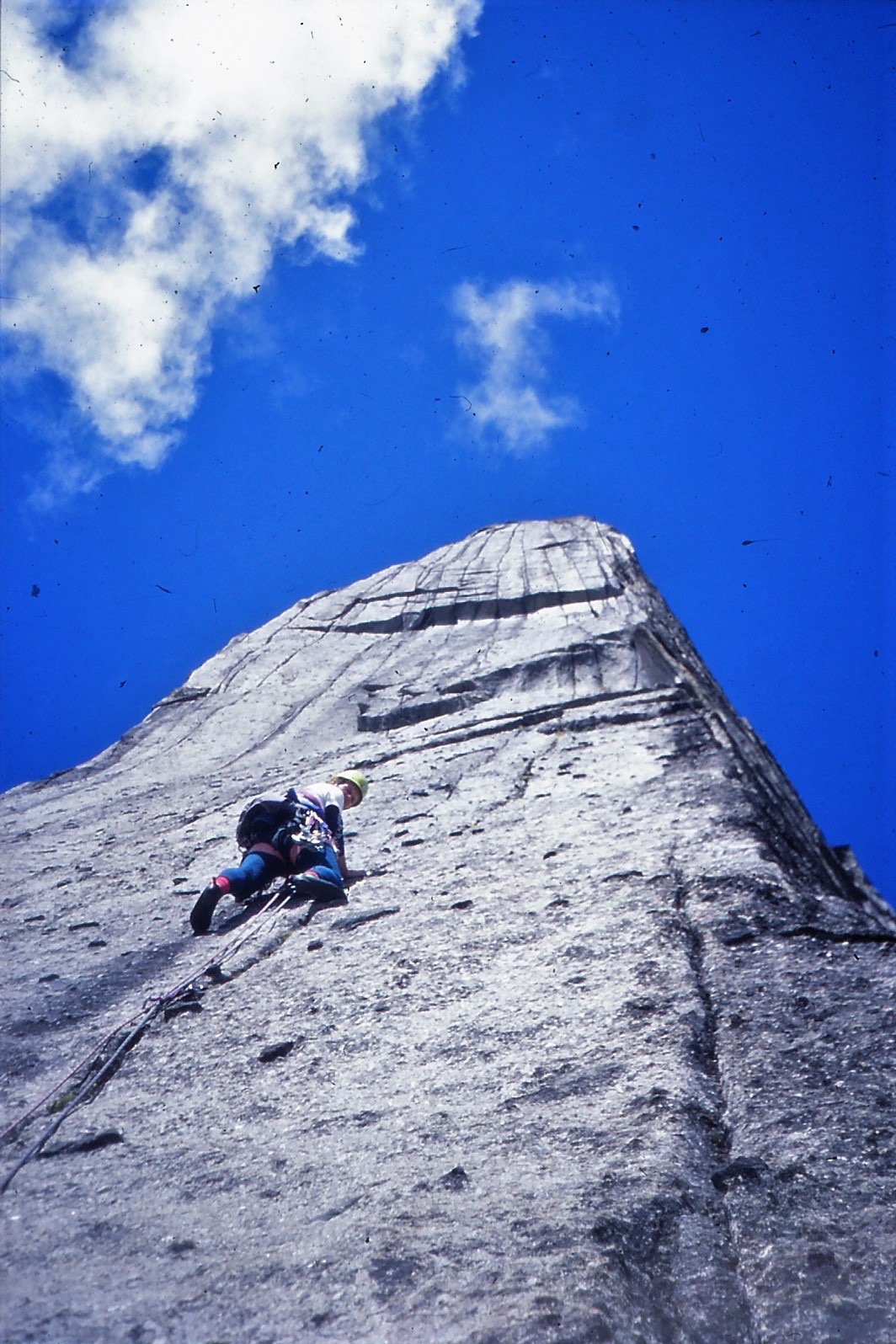
| The Xenolith Headwall |
Variety being the spice of life, we decided to mix the climbing parties - Grant and Mark would climb with me and Paul would join Matt, for Day Two. To get to the Great Line we had to transcend a notable, grade 20 lay-back corner. Stepping off the top of the snow cone at 7 am Mark made light work of this 30m pitch - particularly admirable considering his ailment (he was nursing a badly ingrown toenail). This brought us to a stance on the very edge of the face under the parallel cracks, with 350m of fresh air below and to the right of the ledge.
Protruding from the granite matrix are black feltspar xenoliths - knobs of every conceivable shape, size and profile. Although the climb follows the line stipulated by the cracks it is not a crack climb as such. The cracks afford the opportunities for gear and occasional lay-offs. The knobs are the keys to this 300 metre-high climbing wall.
|
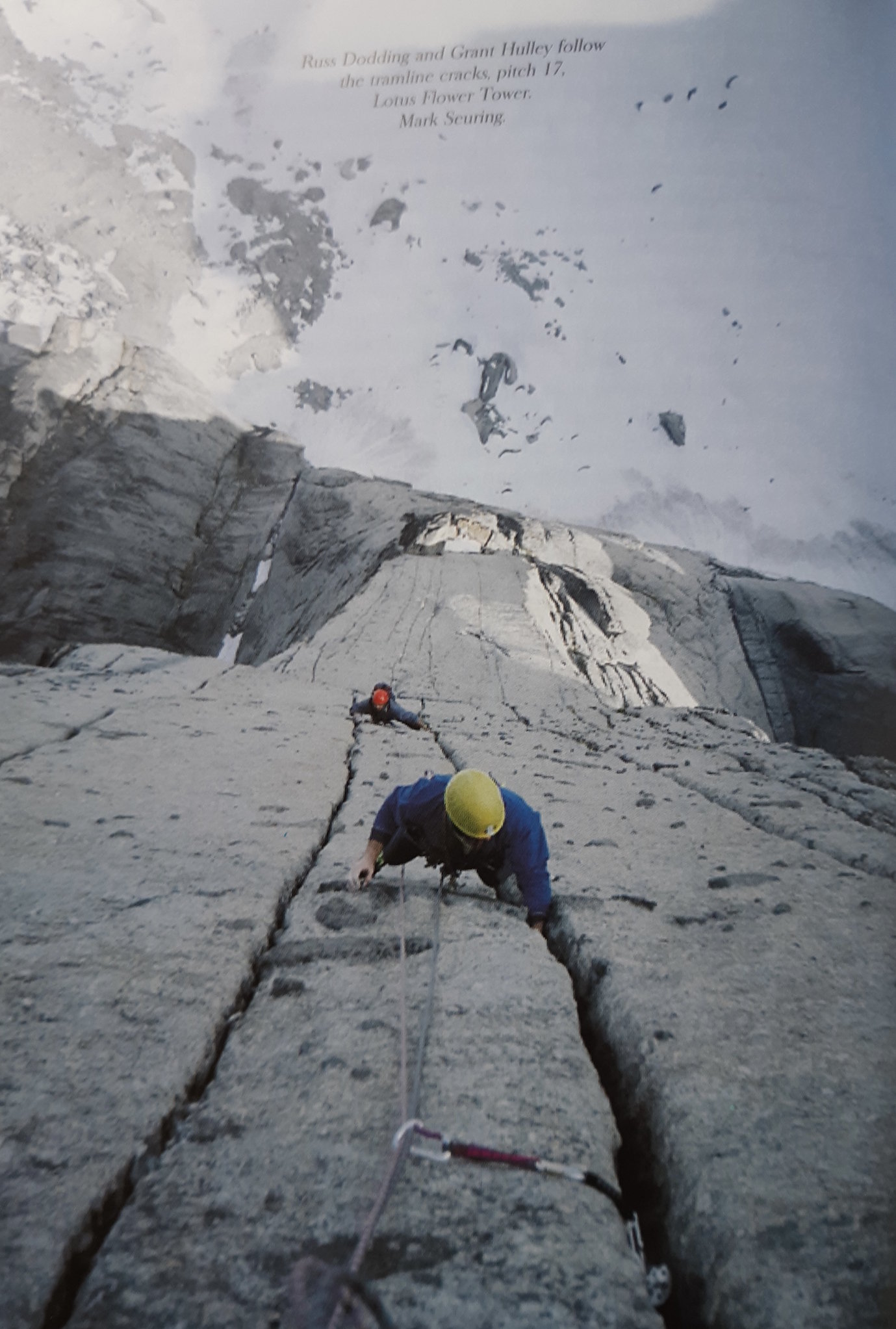
| The Xenolith Headwall |
After five pitches Grant clipped in to the station seven metres below the crux, a one metre-wide roof. Our Swiss friend's attempt had finished here - confirmed by the lack of fresh abseil cord above that point. With one rest Grant got the roof crack (grade 22) sorted out and cruised up the difficult, overhanging wall above to the next station. Seeing him sit back onto the anchors above the roof, I knew that we would not fail. Mark floated up - I was quite happy to resort to a basic mountaineering ethic and stood in two slings through the roof. Matt, in the second party, dynoed through the 5.10c roof with the bravado of a virtuoso sport climber.
Pitch 17 was one of the best pitches that I have ever climbed: twin, tramline cracks about one metre apart and liberally sprinkled with knobs. Every move was grade 19 and there was no respite in the full 48 metres. Mark romped up, ignoring the pain from his toe. Only an unprotected layback off-width crack stood between us and the summit. This dispensed with, Grant, Mark and I topped out at 6 pm. A pearl of moisture collected in the corner of my eye - I was ecstatic to have completed the ascent in good conditions, on our first attempt and with such great company. Destiny had smiled on us. Matt and Paul arrived at 8:30 pm wearing broad grins. We took some photographs and tried to absorb the magnificence of the panoramic view. To the north-west the mountains, ice fields and glaciers of the Logan range seemed to stretch away forever. It was heavenly. 'Sunbeams played like butterflies around the flower of stone.'
Grant could not understand the need for Paul and I to discuss the abseiling strategy. "Surely you just throw the ropes over the edge and rap?" he asked. With 670m of rock to be rapped in the 'night', and knowing we were weary I was nervous of any problems. Paul suggested that we abseil in the same parties that we had climbed in that day, and that the party going first should wait to pull their ropes down until after the second party had successfully recovered their ropes from the previous abseil. In that way the second party could not become stranded, without ropes to abseil. This excellent suggestion was to prove invaluable ... .
Commencing at 9 pm we abseiled, with the bottom ends of the ropes knotted together. On only the second rap the knot became inextricably lodged around an old bong piton inside a deep crack: no amount of pulling in any direction would release it. Frustrated and nervous of my location I arranged for Paul to send down his miniature penknife and I then cut a metre and a half off the ends of both ropes. It was going to be a long night! Five more abseils down to the bivi went without incident and afforded the opportunity of further inspection of the headwall we had climbed. Grant found a Camalot wedged in a crack - nice winnings! The night was completely calm, the silence broken only by the occasional call of " Rope Free!"
The Swiss lads had warned us about the rope-snag potential on the easier angled slab below the bivi ledge: they had the good sense to take a spare rope with them. In the approaching gloom of midnight and despite the warning, Paul and Matt were unfortunate to jam one of their ropes behind a hollow flake. This necessitated chopping seven metres off one of their pair of ropes, and an intermediate abseil off a pedestal. Such exercises took time to execute with safety in the 'darkness'. As a result we only had three ropes which were sufficiently long to complete the abseil. This meant that we had to abseil as a five-man party - slow, but safe. There were other problems too: we had to locate the rap stations in the gloom (my good night vision helped here) and to endure the discomfort of five people tied into one set of bolts. When a ledge was available this was fine, but in the bottom dihedral of the route where the rock was steep and without ledges, there developed a multiplicity of arms, legs and individual belay slings as we all hung from a two-bolt abseil point. After 15 abseils, and at 3.30am, we stood on terra firma, tired and hungry, but very relieved. We had climbed the Lotus Flower Tower within 90 hours of having arrived in the Cirque and we couldn't believe our good fortune.
We staggered back to the camp, had tea and collapsed into our respective tents. A brunch was taken at noon and then it was back for more sleep. During that afternoon (June 28) it began to rain and this continued almost without interruption for the next six days. Our gamble to arrive in the Cirque at the very beginning of the recognized climbing season had paid off. We had been given, and had gratefully accepted, a window of opportunity to climb. There were times when I doubted our sanity: we had spent so much money on travel (R9 000 each) and had traveled so far, to an area so well-known for its fickle weather - but topping-out made it all worthwhile. As Paul would put it: "You can't argue with success!"
The following day we had to return in the rain to Glacier Lake, as we had virtually run out of food. The stash was intact and we gorged ourselves on salami, cheese, tuna, apples and chocolate. There was much evidence of bears being present in the area, but we fortunately didn't have a face-to-face encounter with these locals! Then, with packs weighing only 17kg each we cut our time back to Fairy Meadow to three hours.
There are few birds in the Cirque and little else making a noise other than the wind howling around the rock walls. Lying in the tents whilst it rained, reading and dozing, the most welcoming sound was the call of: "Bread's ready!" from the cooking shelter. With an MSR stove-top oven we produced some remarkable doughnut-shaped loaves; the importance of freshly-baked bread for one's wellbeing cannot be over-emphasised. Pancake quality also improved.
Two days before Paul had to leave the Cirque for his conferences in Vancouver, the weather cleared sufficiently for him, Mark and me to make an ascent of Mt Sir James MacBrien, at 2760m the highest peak in the area. The route was a 10-pitch up to grade 19 on the south-east arete, and we climbed it under leaden skies. The upper pitches, in a chimney/groove system, were the stuff of a nightmare - cold, loose, a smattering of snow, and tricky. After an 18-hour round trip we were relieved to get back to camp. On our descent we had encountered mountain goats and ptarmigans.
Paul left the cirque on July 6, dodging a final volley of rockfall from the upper reaches of Mt Sir Harrison Smith. His pick-up plane dipped a wing at our camp as it flew past the massive entrance to Fairy Meadows. Base camp lethargy set in amongst the remaining four, aided by a further deterioration in the weather. This meant walks in the rain to see the small glacial lake below Bustle Tower, climbing bolt-protected routes on boulders in the Meadows (including a memorable grade 29 by Mark), baking scones, reading and keeping warm. A helicopter ferried backwards and forwards into the adjacent valley below the 600m face of Proboscis - presumably bringing in money-rich climbers. As a storm abated on July 7, two Scottish climbers arrived - the first people we had seen since the Swiss lads had left 11 days previously. I learnt later that the Scots had failed on the Lotus because of bad weather, despite having been in the Cirque for nine days.
With our food stores virtually depleted, Grant, Matt, Mark and I descended from Fairy Meadow on July 9, in appalling weather. The Cirque of the Unclimbables is an incredible and awe-inspiring location, but very harsh, and I was happy to descend to the relative luxury of valley life, mosquitoes and all.
Grant and Matt launched their two-man inflatable raft on Glacier Lake to tackle the South Nahanni River on the morning of July 10 - I wondered if we would ever see them again. That, as they say, is another story. Mark and I fished for Arctic grayling to supplement the little food that we had left. Our stay in this remote area was nearing its end and when the silence was shattered by the steady drone of the Beaver's engine on July 12, we were mentally prepared to face the developed world again.
Climbing the Lotus Flower Tower was important to me for many reasons. That I was able to achieve it in such fine company and in genuine comradeship was a real pleasure. The old Roger Baxter-Jones words, "Come back alive, come back friends, get to the top ... in that order," never rang so true.